
Wisdom as the Science of Zooming In and the Art of Zooming Out
Where intuition and intellection fail us
Aetas parentum, peior avis, tulit
nos nequiores, mox daturos
progeniem vitiosiorem.
What do the harmful days not render less?
Worse than our grandparents’ generation,
our parents’ then produced us, even worse,
and soon to bear still more sinful children.
Odes 3.6, Horace (23 BC)1
Throughout history, many intelligent people have intuited that the world is going to hell in a hand basket, that young people are immoral, and that society as a whole has lost its moral sense. Sometimes people will buffer such a sentiment with hope concerning a small subset of the population that is swimming against the tide, but even then the general sense is that the world at large is crumbling. Of course, if this were true, mankind would have been in continuous decline since the dawn of our race, and our hunter-gatherer ancestors would have been saints. Even if not starting at the beginning, there is no point in history from which we can see a steady descent. I for one am proud that we no longer have cult prostitution in our places of worship (2 Kings 23:7), socially acceptable and widespread slavery, concubinages for men of wealth and power, and the burning alive of people with different beliefs or views. With all seriousness, imagine if a bishop today had a team of theologians examine the testimony of a 19-year-old girl and then decided that she should be burned alive in the center of the town (i.e. Joan of Arc, 1431). I think we have made progress since then.
That the world is in continual moral decline is just one example of where intuition can fail us, though intuition itself is a powerful gift. A thorough and honest look at the data would never support such a claim. In general, this tendency to project an overarching meaning on to reality but which is not grounded in the reality itself is problematic. The tendency may have its origins in:
- the need for coherence - I experience great discomfort when reality fails to make sense or meet my expectations and this makes me anxious or angry. I therefore feel a compulsion to re-establish coherence as soon as possible. Sometimes I achieve this by condemning reality to find myself and my group securely above it. Other times, I bend the facts to match a narrative or ideology.
- flippancy, sensationalism, or a general lack of concern with accuracy - This is how old wives’ tales get passed along, or contemporary health fads, for example. Even systematically disproving them would be of no avail in stemming their spread because they are immune to reason by design.
A different but related problem comes from unbounded intellection and drifting off into speculation, while becoming increasingly aloof from reality. Tremendous intellectual power is misapplied in speculation because of its appeal to brilliant minds. To make matters worse, the novelty of speculation wins the hearts of many audiences, reinforcing the unproductive habit. For listeners, speculative orations feed their curiosity (Neugier in German – literally, greed for new things) like nothing else can because it keeps producing novelties at lightning speed, unfettered by the nuances and constraints of reality.
Where deconstruction becomes destructive
On the other end of the spectrum, we find the tendency to deconstruct matters into their most basic parts and to try to make sense of reality from these fragments. The hope is that pouring over every painstaking detail will bring the truth to light. This has advantages over the aforementioned tendencies because it is disciplined and thorough and grounded in the reality itself. The problem is that the realities we are trying to uncover will mysteriously slip by us while we are rigorously drilling into them. A man was so curious about time that he pulled apart a clock to examine every one of its gears. In the end, he understood the clock perfectly, from the ground up, but he knew nothing more about time than when he began. As he meticulously delineated every feature of its most irreducible gear, he forgot all about what he set out to find in the first place. Thinkers who lean in this direction abandon the larger project of making sense of reality and become content with understanding their simplified models of reality. This is not to say that the simplified models are simple. They are very complex, but they are simplified with respect to the reality that they are modeling or addressing. Some people subject themselves to a never-ending series of blood tests and diagnoses, for example, following an increasingly more complex and expensive medication regimen, while their illness keeps evading their grasp and reappearing in new forms. Perhaps the illness pertains more to the whole than to many parts.2 This tendency, in general, can be described as not seeing the forest for the trees. Deconstruction becomes destructive whenever it is reductive.
Seeing the wider world
Almost all statements that include “Gen Z is…” are hasty generalizations (though not this one, of course). And yet, there really is such a thing as Gen Z. There really is “society nowadays,” even while most of our statements about it do not capture it. Who then is able to capture it? The media cult follows fads that fade as quickly as they form and which altogether lack import. Social researchers get lost in statistics, which is often the wrong instrument for measuring the Zeitgeist (the spirit of the times). When a person takes a questionnaire that asks him something like, “How happy are you?,” how on earth could he answer while doing justice to the nuances of his feeling? No single individual’s spirit can be properly measured in questionnaires, much less that of a whole population. Meanwhile, some researchers believe they can explain our world unilaterally through game theory or genetics or neuroscience or economics or some other narrow discipline. Clearly, we are in desperate need of wisdom, of people who see the big picture that emerges from all the phenomena of lived experience.
In 1988, Pope St. John Paul II wrote:
Science can purify religion from error and superstition; religion can purify science from idolatry and false absolutes. Each can draw the other into a wider world, a world in which both can flourish.3
Now there is someone who saw something: where things stood, where things were going, where they could end up. Let us try to live in that wider world that he describes.
The science of zooming in
We must appreciate the scientific enterprise, inasmuch as it saves us from unbounded speculation and superstition. Whether we are directly involved in science itself or not, we should learn from it. Its patient and methodic crawl to the truth is something praiseworthy, centered around the mental discipline of only asserting falsifiable claims. The science of zooming in is about isolating variables, establishing controls, and testing every idea. As we saw from John Paul II, religion could learn a lot from this.
Instead of making hasty and unfalsifiable claims about the origins and remedies of anxiety or jealousy, for example, we should first carefully zoom in to the phenomena. To do so, we would have to first acknowledge the unmistakable fact that anxiety and jealousy are observed in other animals too. They probably provide some evolutionary advantage. Our non-speculative teachings would have to be constructed upon these animal foundations to be honest. As it stands, many of the explanations out there are so lofty that, unbeknownst to their authors, they end up ascribing a spiritual character to something mere animals experience. Zooming in requires the patience of small steps and the humility of following the evidence, despite the urgent need for coherence.
The art of zooming out
A researcher may be knee-deep in a difficult problem when he is called away from his desk. Everyone knows that just getting up, stepping away, perhaps stepping outside, and physically seeing a broader view can provide fresh perspective on any problem. Sometimes a bit of music can make the whole world change in an instant. Life looks different with headphones on, like if you were to watch all the people flurrying about the airport but while listening to Louis Armstrong’s “What A Wonderful World”. The music colors the experience, or rather, it accentuates a deeper aspect of reality that is otherwise lost in the commotion. Indeed, artists are especially gifted in capturing deep realities, the whole, or the Zeitgeist, typically through an intuitive and pre-reflective genius. Their works help us scale the heights of Being, if but for a moment, and to see the big picture. Beauty, nature, music, art – these are all helpful for “zooming out” – as are interactions with loved ones and children. They snap us out of that rabid fixation that keeps going long after having lost sight of its purpose. Nothing zooms out more magnificently than daily contemplative prayer, in which the Holy Spirit lets us share in the universal Mind of Christ and even reveals to us the unfathomable depths of God.
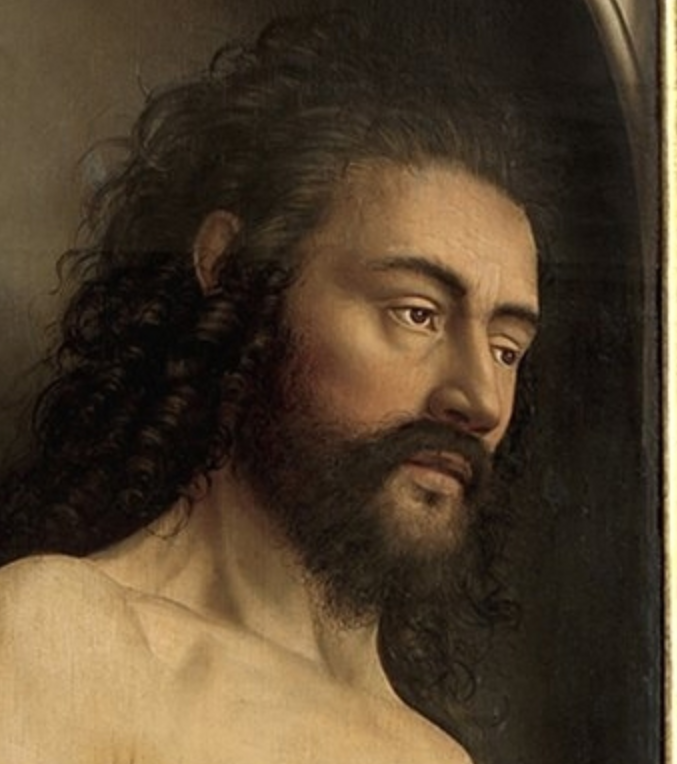
Jolly recently visited St. Bavo’s Cathedral in Belgium and shared a breathtaking photo with our team of The Adoration of the Mystic Lamb by Hubert and Jan Van Eyck from 1432. Just one aspect of that masterpiece, Adam’s eyes, in an instant of intuition, can tell us something about the heart of man that could not be attained from reading even copious amounts of anthropological literature.
Conclusion: the call for wisdom figures
The world needs people who have the discipline, focus, and honesty of zooming in while simultaneously possessing the imagination, interiority, and receptivity to approach the greater mysteries of existence. We need people whose heads are not lost in the clouds of speculation, the intellectual’s drug of choice, and whose heads are not buried in the earth, in that convenient but dishonest reduction of reality that contradicts daily experience.
Can we become those wisdom figures? Wisdom beckons every person. It invites each one of us to embark upon a quest. The seventh chapter of the biblical book, Wisdom, from the first century BC writes:
I prayed, and prudence was given me;
I pleaded and the spirit of Wisdom came to me.
I preferred her to scepter and throne,
And deemed riches nothing in comparison with her,
nor did I liken any priceless gem to her…
Beyond health and beauty I loved her
God hears such a prayer and grants this noble request.
For he gave me sound knowledge of what exists,
that I might know the structure of the universe and the force of its elements,
The beginning and the end and the midpoint of times,
the changes in the sun’s course and the variations of the seasons,
Cycles of years, positions of stars,
natures of living things, tempers of beasts,
Powers of the winds and thoughts of human beings,
uses of plants and virtues of roots—
Whatever is hidden or plain I learned,
for Wisdom, the artisan of all, taught me.
Such wisdom is not merely abstract or speculative. It seeks to understand the position of the stars (astronomy). It explores the uses of various plants (medicine). Clearly, wisdom zooms in!
Wisdom also zooms out. The author goes to explain that wisdom:
- “penetrates and pervades all things”
- “is a breath of the might of God and a pure emanation of the glory of the Almighty”
- “is the reflection of eternal light, the spotless mirror of the power of God, the image of his goodness”
Knowing our frailty, the debility of our intellect, and the impenetrability of existence can make the prospect of attaining wisdom seem impossible. This is why the text suggests that wisdom is to be prayed for and received. In other words, we must ask for it! For…
Passing into holy souls from age to age, wisdom produces friends of God and prophets. For God loves nothing so much as the one who dwells with Wisdom.
-
Horace (Quintus Horatius Flaccus), “Odes, Book III, Ode 6”, in The Odes of Horace: A New Verse Translation (translated and edited on Poetry in Translation), accessed February 20, 2026. ↩
-
For example, the Surgeon General warned that “the mortality impact of being socially disconnected is similar to that caused by smoking up to 15 cigarettes a day.” But it is not likely that one’s doctor would recognize that one’s heart or gut maladies are the result of loneliness. –> United States Public Health Service, Office of the Surgeon General, Our Epidemic of Loneliness and Isolation: The U.S. Surgeon General’s Advisory on the Healing Effects of Social Connection and Community (Washington, DC: U.S. Department of Health and Human Services, May 3, 2023). ↩
-
John Paul II, “Letter to Reverend George V. Coyne, S.J., Director of the Vatican Observatory”, June 1, 1988. ↩